Source: USDA news release
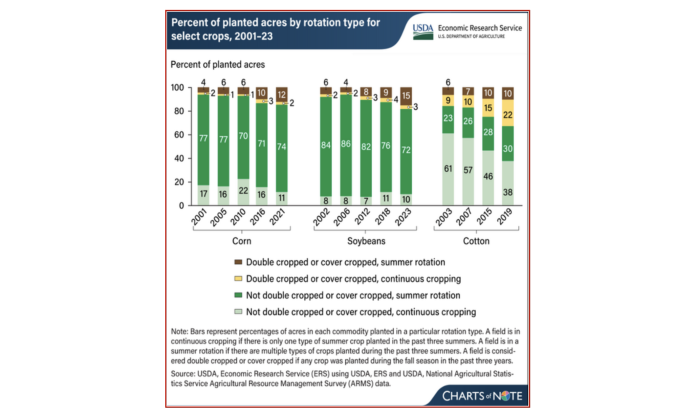
The last two decades have seen a significant increase in farmers using either double cropping or cover cropping on corn, soybean, and cotton fields. Double cropping is the practice of planting a crop in the fall between summer crops (such as planting winter wheat after corn has been harvested or planting soybeans following a winter wheat harvest) to increase the productive value of a single field.
Cover crops are unharvested winter crops grown primarily for their soil health and environmental benefits. Cover cropping can be incorporated into either a summer rotation (where the summer crop in a field alternates across years, such as a corn-soybeans rotation) or with continuous cropping (where the main crop over the warm season is the same over a period of years).
Cotton fields have seen the largest increase in these practices, with the area under either double cropping or cover cropping growing from 15 percent of acres in 2003 to 32 percent of acres in 2019. The data suggest that the decline in single cropping is largely driven by expanded use of cover crops.